A strong project management office comes down to eight habits: a clear mandate, standards that stay light, projects tied to strategy, trained people, open communication, balanced workloads, shared lessons, and metrics that drive improvement. Get these right, and a PMO stops being a layer of paperwork and becomes the group that helps teams deliver what the organization actually needs.
Why does this approach work? Most PMOs struggle for the same reason. They try to control everything before they’ve explained why they exist. Teams see forms and approvals, not value. The practices below flip that pattern. They start with purpose, protect people’s time, and build trust through clarity.
Whether you’re launching a PMO from scratch or refreshing one that has lost momentum, you don’t need a large budget or a big team to begin. A single clear goal and one shared template can change how work moves through your organization within a few months.
For corporate leaders, HR professionals, and training managers, this matters in a particular way. A PMO is a people system as much as a process system. It shapes how skills grow, how workloads stay fair, and how knowledge travels from one project to the next.
This guide walks through eight practices, explains how we chose them, and shows success stories and case-style examples so you can picture each one in your own workplace. Use the key takeaway and FAQ to jump straight to what you need.
How We Chose These PMO Practices
This list is curated, not tested. We didn’t run experiments or collect new figures. Instead, we drew on widely recognized project management principles and the everyday experience of organizations that have built PMOs, then kept the practices that showed up as dependable, sensible and worth your time.
Four criteria guided the final eight:
- Practical to adopt: you can start with the people and tools you already have.
- People-centered: each practice builds skills, trust and shared understanding.
- Scalable: it works for a ten-person team and a multi-department organization alike.
- Measurable: you can tell, over time, whether it’s making a difference.
We also looked for lasting value. Fads come and go, but clear purpose, honest communication and shared learning stay useful year after year. Many of these ideas echo the same habits that help you manage administrative tasks well: simple routines, clear ownership and steady follow-through.
Treat the list as a menu, not a mandate. Pick the practices that fit your organization’s size and stage, and build from there.
1. Define a Clear PMO Purpose and Mandate

A PMO without a clear purpose quickly becomes a source of friction. Teams wonder why they are filling out forms, and leaders wonder what the office is actually delivering. Starting with the “why” prevents both problems.
Begin by sitting down with senior leaders to agree on three things: the PMO’s mission, its scope, and its level of authority. The mission answers the simplest question, which is what problem this office exists to solve. Scope sets the boundaries. Will the PMO cover every project in the organization, only the large cross-department ones, or a single division to start? Authority is where expectations most often drift apart, so name it directly. A supportive PMO offers templates, coaching, and guidance. A controlling PMO requires teams to follow set standards and checks. A directive PMO takes on the management of projects itself. None of these is right for everyone, and many organizations begin supportive and grow from there.
Once the mission is set, share it widely and put it in writing. A PMO that spends less time on routine admin, perhaps because it knows what to delegate or automate has more room to focus on the work its mandate calls for. Shared expectations on day one make every later practice easier to adopt.
2. Standardize the Essentials, Not Everything
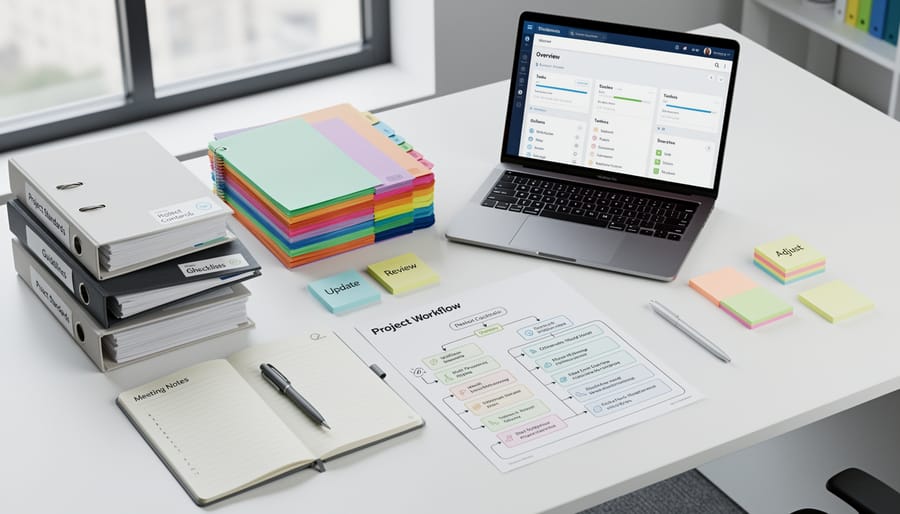
A good PMO makes the right things easy, not every thing mandatory. Start by asking where teams lose the most time to confusion: unclear status updates, mismatched project kickoffs, or reports that look different every week. Those are your candidates for standardization.
Aim for a small starter kit. A one-page project brief, a simple status report, a basic risk log, and a short closeout checklist cover most of what teams need. Keep each template in plain language, with clear prompts instead of dense instructions. If a field doesn’t help someone make a decision, remove it.
Workflows deserve the same light touch. Map the few steps every project shares, such as approval, kickoff, monthly review, and handover, and let teams decide how they work between those checkpoints. A marketing team running quick campaigns doesn’t need the same rhythm as a facilities team managing a long renovation.
Standard tools only work when people feel comfortable using them, which is why people skills matter as much as the templates themselves. Invite project leads to help shape the formats, and ask for feedback after a few months. When teams see their input reflected, adoption follows naturally.
Review the kit once or twice a year and retire anything that has stopped earning its place.
3. Align Projects With Strategic Priorities

A PMO earns its place when it helps leaders say yes to the right projects and a calm, clear no to the rest. Without that filter, organizations tend to start too many initiatives, and every team ends up stretched thin.
Start with transparent criteria. Agree on a short list of questions every proposed project must answer: Does it support a stated strategic goal? What value does it create for customers or employees? What will it cost in time, money, and attention? When the criteria are visible to everyone, decisions feel fair, and people understand why a project moved forward or waited.
Next, hold regular portfolio reviews. A quarterly session where leaders look at all active and proposed work side by side keeps priorities fresh. Projects that no longer fit can be paused or reshaped, and new opportunities get a proper hearing rather than being squeezed in informally.
Finally, make room for honest conversations about capacity. A PMO can show what the organization can realistically deliver with the people it has. That view turns a tense debate into a practical one: if we add this, what comes off the list?
The result is focus. Teams spend their energy on work that moves the organization forward, and leaders gain confidence that effort is going where it matters most.
4. Invest in People: Training and Skill-Building

A PMO is only as strong as the people behind it. Templates and dashboards help, but projects succeed because someone knows how to scope work, ask the right questions, and lead a team through uncertainty. That is why this practice sits at the heart of human capital development: when you build project skills across the organization, you build confidence along with capability.
Start by looking at where people actually are. A new team member managing a first project needs different support than a seasoned lead juggling several initiatives. A good PMO matches learning to the role, then makes it easy to take the next step. Coaching matters here too. Pairing project leads with experienced colleagues gives them a safe place to talk through decisions and learn from real situations, not just theory.
Learning does not have to mean long courses or big budgets. Small, regular opportunities often work best:
- Onboarding workshops that introduce the PMO’s tools and expectations
- Peer mentoring that connects newer leads with experienced practitioners
- Lunch-and-learn sessions where teams share what worked on recent projects
- Role-based training plans that map skills to each stage of a career
Over time, these habits create a learning path people can see and follow. Employees start to take initiative, raise issues early, and approach projects with energy rather than hesitation. That is the kind of enthusiastic, capable team CSTD champions, and a PMO that invests in people helps it grow naturally.
5. Build Open, Consistent Communication

Good communication in a PMO is less about volume and more about rhythm. When people know when and where to find information, they stop chasing it, and that alone saves surprising amounts of time.
Start with a concise status update on a predictable schedule, weekly for most teams. Keep it to a few lines covering progress, upcoming work, and anything blocking the way. A simple traffic-light view (green, amber, red) helps readers spot trouble at a glance, but pair every amber or red with a short sentence explaining what is needed to fix it.
Next, set up a shared dashboard that holds the current picture in one place. Include schedules, milestones, risks, and key decisions so stakeholders can check progress on their own instead of waiting for a meeting. Choose a tool your people will actually open, even if that means starting with a well-organized shared spreadsheet.
Finally, schedule regular check-ins, such as a short weekly huddle for project leads and a monthly review with senior sponsors. Use them to surface issues early, while they are still easy to solve. Candor grows when leaders respond to bad news with curiosity rather than blame, so thank the person who raises a concern. Over time, that habit turns the PMO into a trusted partner instead of a reporting office.
6. Manage Resources and Workloads Thoughtfully

A PMO’s most practical gift to leaders is a clear picture of who is working on what, and when. Without that view, workloads drift out of balance. Some people carry three projects at once while others wait for meaningful work, and nobody notices until deadlines slip or someone burns out.
A simple capacity view fixes much of this. Start with a shared sheet or dashboard listing people, current assignments, and rough hours per week. Update it on a regular rhythm, and review it before approving any new project. This lets leaders ask a better question: not “can we squeeze this in?” but “who has room, and do they have the right skills?”
Matching skills to needs matters as much as counting hours. A capable analyst stretched across five initiatives helps no one, while a well-matched assignment builds confidence and pace. Visible workloads also protect people. Sustained overload erodes morale, and healthy staff engagement depends on workloads people can manage.
That scenario is representative rather than a measured result, but the pattern is common. When capacity is visible, conversations become calmer and more factual. Leaders can say yes with confidence, say “not yet” without friction, and spot overload early enough to rebalance the work before it becomes a problem.
7. Capture Lessons Learned and Share Knowledge

Every project, whether it lands smoothly or stumbles, leaves behind insight that most organizations never collect. A PMO can change that by making reflection a normal part of finishing work rather than an afterthought.
Start with a short, blame-free review. Aim for 45 minutes shortly after a project closes, while memories are fresh. Keep the questions simple: What went well? What was harder than expected? What would we do differently next time? Focus on processes and decisions, not individuals, so people feel safe speaking honestly. A neutral facilitator, often someone from the PMO, helps keep the conversation constructive.
Then give those insights a home. A shared library, even a simple folder or internal wiki, works well when entries are brief, searchable, and tagged by theme, such as vendor management or stakeholder communication. If nobody can find a lesson in two minutes, nobody will use it.
Here’s a representative scenario. A mid-sized services firm noticed that several projects had slipped because approvals arrived late. After a review, the PMO added an “approval timeline check” to its planning template and logged the reasoning in its library. On the next project, the planner found the note early, built in extra review time, and kept the schedule intact. One small lesson, recorded and reused, quietly improved every project that followed.
8. Measure What Matters and Keep Improving

A PMO that tracks everything ends up learning nothing. The goal is a short list of measures that tell you whether the office is helping people deliver better work, and three or four is usually plenty.
Start with the questions your leaders actually ask. Are projects arriving when promised? Are the people who depend on them satisfied? Is the team energized or running on fumes? Those questions point naturally to on-time delivery, stakeholder satisfaction, and team engagement. A quick pulse survey after each project handles the second and third, while your status reports already hold the first.
Agree on how each measure is defined before you collect a single number. “On time” should mean the same thing in every department, or comparisons become arguments. Write the definitions on one page and share it widely.
Then build a review rhythm. A monthly check-in works well for most PMOs: look at the trends, pick one thing that surprised you, and decide on one small change to try. Next month, see whether it helped. This steady loop matters far more than any single result.
Treat the numbers as conversation starters, not report cards. When a score dips, ask what the team needs rather than who is at fault. Teams that feel safe sharing honest results improve faster, and the PMO earns trust as a partner in their success.
Progress beats perfection every time. A PMO that gets a little better each quarter will outpace one chasing a flawless dashboard.
Common Questions About Starting or Strengthening a PMO
Starting a PMO raises practical questions, and the answers are usually simpler than leaders expect. Here are four we hear most often.
How large does an organization need to be to have a PMO?
There’s no magic headcount. A PMO makes sense when several projects compete for the same people and leaders need a shared view of priorities. Smaller organizations can start with a lightweight version, even one or two people supporting templates and reporting.
How do we win over skeptical teams?
Start by solving a problem teams already feel, such as confusing handoffs or duplicated status reports. When people see the PMO saving them time rather than adding paperwork, trust follows naturally.
What could the first 90 days look like?
Spend the first month listening and agreeing on a clear purpose with senior leaders. In the second month, introduce a few simple templates and a regular communication rhythm. By month three, review what’s working, gather feedback, and choose a small set of measures to track.
How is a PMO different from a project manager?
A project manager leads the delivery of one specific project. The PMO supports the whole organization by setting shared standards, coordinating priorities, and building skills so every project lead has what they need to succeed.
If you’re feeling unsure where to begin, that’s perfectly normal. Pick the question that sounds most like your current situation and let it guide your first conversation with colleagues. A PMO grows best through small, visible wins that people can see and appreciate.
A PMO earns its place when it serves people first, keeps processes simple, and ties everyday work to the goals the organization cares about most. You don’t need to launch all eight practices at once. Pick the one that would ease your team’s biggest frustration right now, whether that’s a clearer mandate, lighter templates, or more visible workloads, and give it a full quarter to take hold.
Small, steady progress adds up faster than you’d expect, and each improvement makes the next one easier. When you’re ready for a partner on that journey, we invite you to explore CSTD’s consulting and training support to help your teams grow with confidence.